
15 language models, two real jobs: which ones are worth it?
Every price search in our product makes two language-model calls. We benchmarked 15 models on 152 real recorded searches for both, measuring success rate, overall score and real cost. The most expensive option on the list came last on quality.
Every price search on Gheymatshenas needs a language model twice, and the two jobs are nothing alike. First the answer loop: decide what to go and look for in the shops, then write the reply in Persian. Second the relevance filter: take the 20–24 raw listings the crawler returns and keep only the genuine product. We benchmarked 15 models on our own real data for both.
- 15
- models, one identical prompt
- 152
- real recorded searches
- 2
- distinct jobs per search
- 30x
- cost spread, first to last
Job one: the relevance filter
This call runs on every search and carries the volume. The headline measure is simple: of the searches that had actually shown a user "nothing found", how many does the model rescue? The second measure matters because the opposite failure is just as bad: how often did it keep the entire list, i.e. not filter at all?
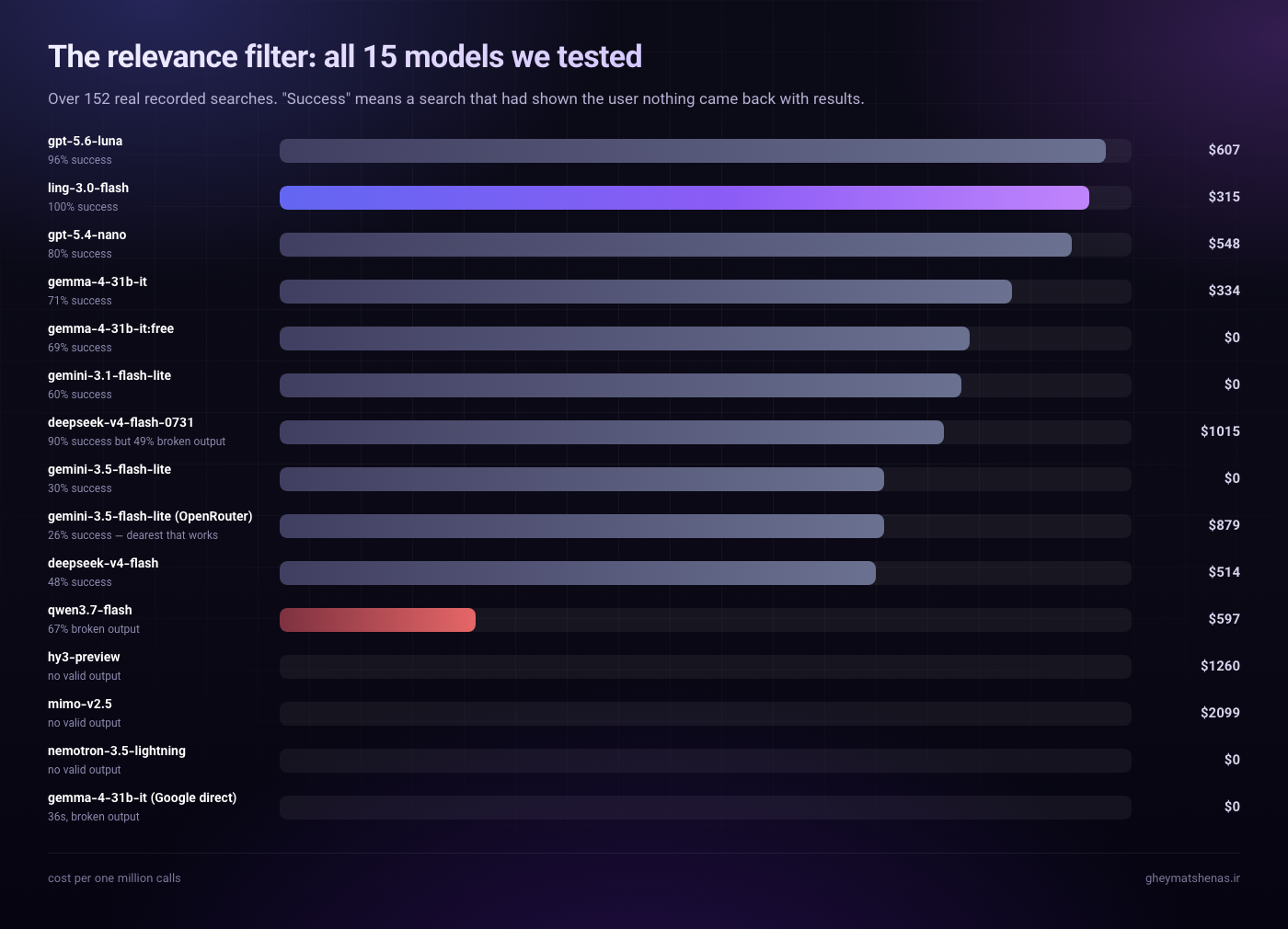
| Model | Score | Success rate | Kept whole list | Latency | Cost / 1M calls |
|---|---|---|---|---|---|
| gpt-5.6-luna | 97 | 96% | 5% | 568ms | $607 |
| ling-3.0-flash | 95 | 100% | 10% | 908ms | $315 |
| gpt-5.4-nano | 93 | 80% | 0% | 594ms | $548 |
| gemma-4-31b-it | 86 | 71% | 15% | 604ms | $334 |
| gemma-4-31b-it:free | 81 | 69% | 17% | 1371ms | $0 |
| gemini-3.1-flash-lite | 80 | 60% | 0% | 1804ms | $0 |
| deepseek-v4-flash-0731 | 78 | 90% | 0% | 1288ms | $1,015 |
| gemini-3.5-flash-lite | 71 | 30% | 0% | 1345ms | $0 |
| gemini-3.5-flash-lite (OpenRouter) | 71 | 26% | 8% | 736ms | $879 |
| deepseek-v4-flash | 70 | 48% | 21% | 1399ms | $514 |
| qwen3.7-flash | 23 | — | — | 978ms | $597 |
| hy3-preview | 0 | — | — | 2752ms | $1,260 |
| mimo-v2.5 | 0 | — | — | 1344ms | $2,099 |
| nemotron-3.5-lightning | 0 | — | — | 514ms | $0 |
| gemma-4-31b-it (Google direct) | 0 | — | — | 36,308ms | $0 |
Two things in that table surprised us. The cheapest paid option (ling) has the highest success rate — the only model that rescued all 109 blank searches it saw. And the most expensive option that works at all (gemini-flash-lite bought through OpenRouter, $879) has the lowest: 26%. Nearly three times the money for a quarter of the result.
The last five could not produce valid JSON at all. Three of them keep "thinking" up to whatever ceiling you give them and never reach the answer — and two of those are among the most expensive rows in the table. They charge for failing.
Job two: the answer loop
Here the model has to call the search tool correctly and then write the Persian answer. We measure two things no public benchmark reports: whether every number it writes really appeared in the price list it was shown, and whether it fires one search per question rather than several.
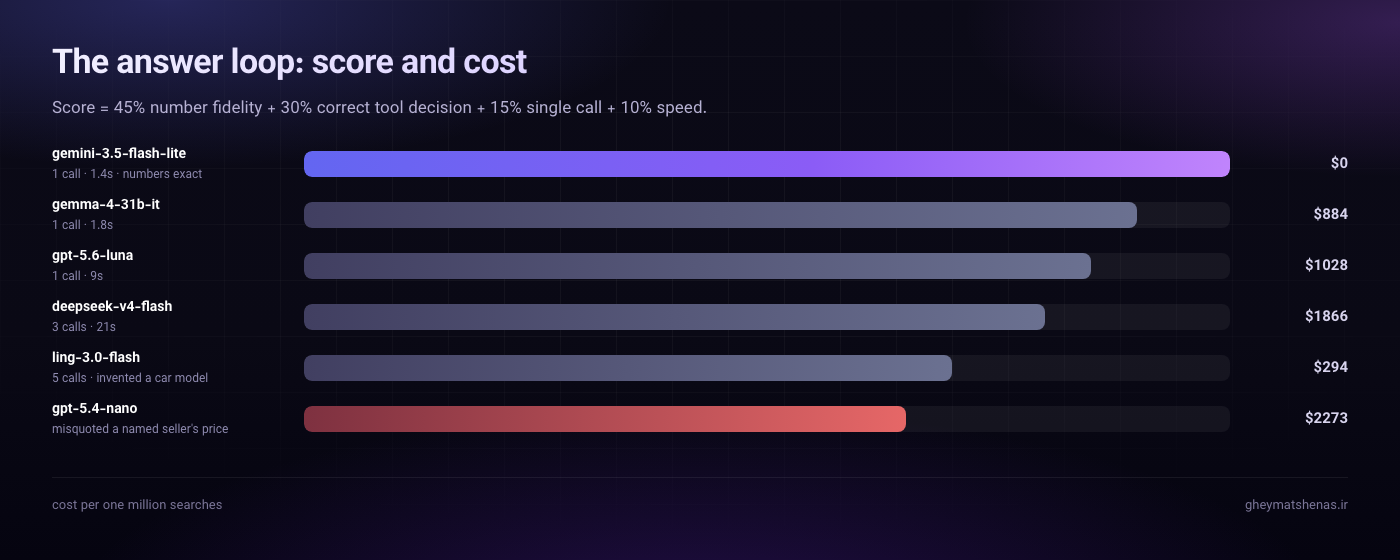
| Model | Score | Number fidelity | Tool decision | Calls per question | Latency | Cost / 1M searches |
|---|---|---|---|---|---|---|
| gemini-3.5-flash-lite | 100 | 2 of 2 | 3 of 3 | 1 | 1.4s | $0 |
| gemma-4-31b-it | 90 | 5 of 5 | 2 of 3 | 1 | 1.8s | $884 |
| gpt-5.6-luna | 85 | 5 of 6 | 3 of 3 | 1 | 9s | $1,028 |
| deepseek-v4-flash | 80 | 9 of 9 | 3 of 3 | 3 | 21s | $1,866 |
| ling-3.0-flash | 70 | 9 of 9 | 2 of 3 | 5 | 9s | $294 |
| gpt-5.4-nano | 65 | 4 of 9 | 3 of 3 | 1 | 14s | $2,273 |
| gemini-3.1-flash-lite | — | not measured | 3 of 3 | 1 | 1.7s | $0 |
Two models were ruled out here for reasons no public benchmark reports. ling fired five searches for one question and invented a Peugeot 207 for a query about a Pride 1400 — and each search is a live crawl on the user's own machine. gpt-5.4-nano scored full marks on output format and then wrote that the cheapest price was 74,500,000 toman when that shop's real price, in the very list it was given, was 75,450,000. For a price comparison site that is the worst kind of error: everything looks right and only the number is wrong.
Price per token does not predict what a request costs
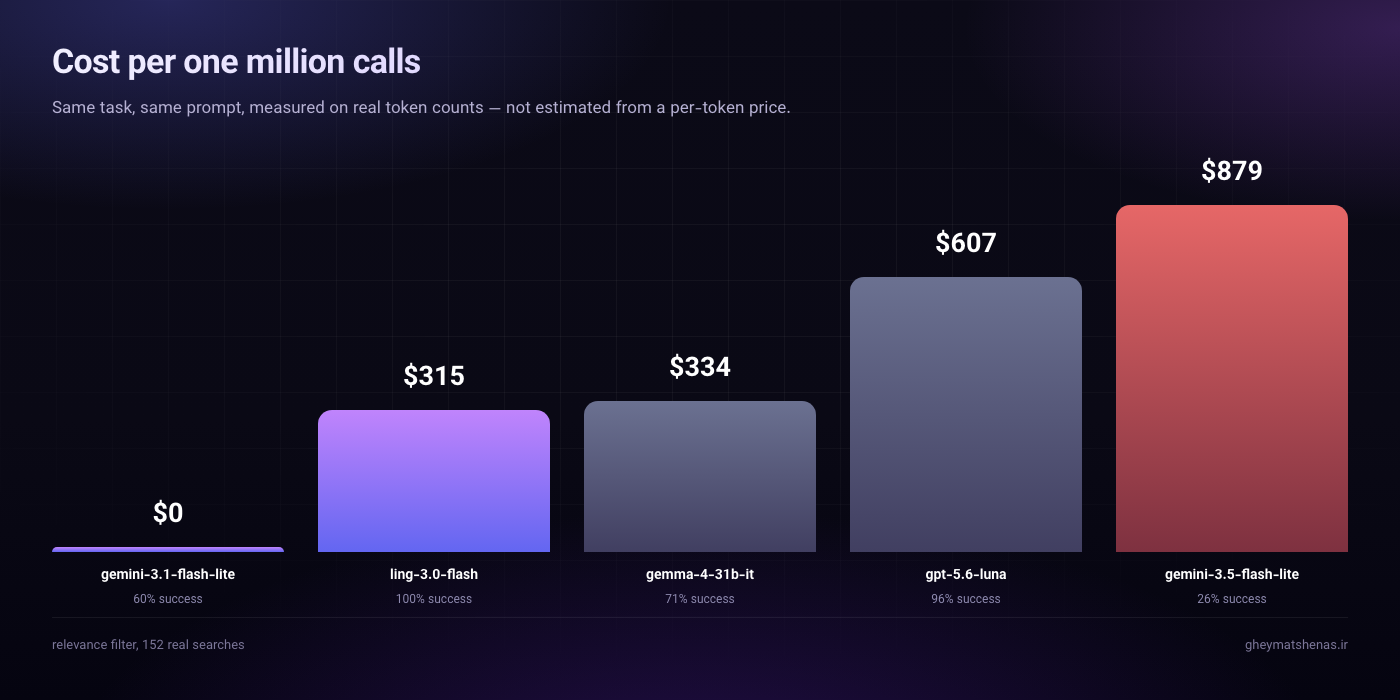
This was the most useful practical lesson. A model billing a tenth of the going rate per token can cost several times more per request, because it spends hundreds or thousands of tokens "thinking" before every answer and those are billed too. The only way to know is to send your own real prompt and read the invoice.
What we picked
- For the relevance filter: ling-3.0-flash — the only model with a 100% success rate, at half the price of the next one.
- For the answer loop: gemini flash-lite — one call, fastest, and its numbers were exact. Models that fire several searches per question have no place here.
- Ruled out: gpt-5.4-nano for the wrong price, and the five models that never produced valid output.
Limits of this benchmark
- It measures two specific jobs, not general model ability.
- Every model got the same prompt at temperature zero; each would probably do better with a prompt tuned to it.
- The filter table rests on 152 searches; the answer-loop table on three tool probes and one prose sample — far weaker.
- Each search was run once, and we have previously measured that a model does not always give the same verdict on identical input.
This continues our earlier benchmark on 112 Persian searches, and the token-budget bug report explains why half of these models looked broken at first. You can see the result on live prices.